By inDirectIT, Inc. · Planning guidance from our engineering practice.
What the timeline depends on
If you've already worked through whether you need GCC High at all, the next question is always how long until we're actually in? The usual answer is "it depends," which is true and unhelpful until someone names what it depends on. Those are specific, nameable things, and most of them are in your control.
Our published Migration + DFARS 7012 Enablement package ($25K + $250/user) runs about six weeks in typical delivery. A complete GCC High enclave build, the full CMMC Factory Baseline, runs about twelve weeks typical. Every duration below is a typical figure, and seat count and data volume can move it in either direction.
The one factor you can't compress is eligibility validation. You can't buy GCC High from a checkout page. Microsoft first validates that your organization is eligible (for a contractor, that it holds regulated data such as CUI or ITAR-controlled data), and licenses are then sold through specialized channels with real lead time. Order early, because every later phase waits on the licenses.
- A six-phase timeline with typical week ranges for the packaged migration, plus where the twelve-week full enclave build differs.
- The critical path: the dependencies you can't parallelize, no matter how many people you throw at them.
- The four things that blow up timelines, so you can defuse them before week one.
- The enclave shortcut, and how scoping down before you migrate can cut the whole project roughly in half.
The six phases, week by week
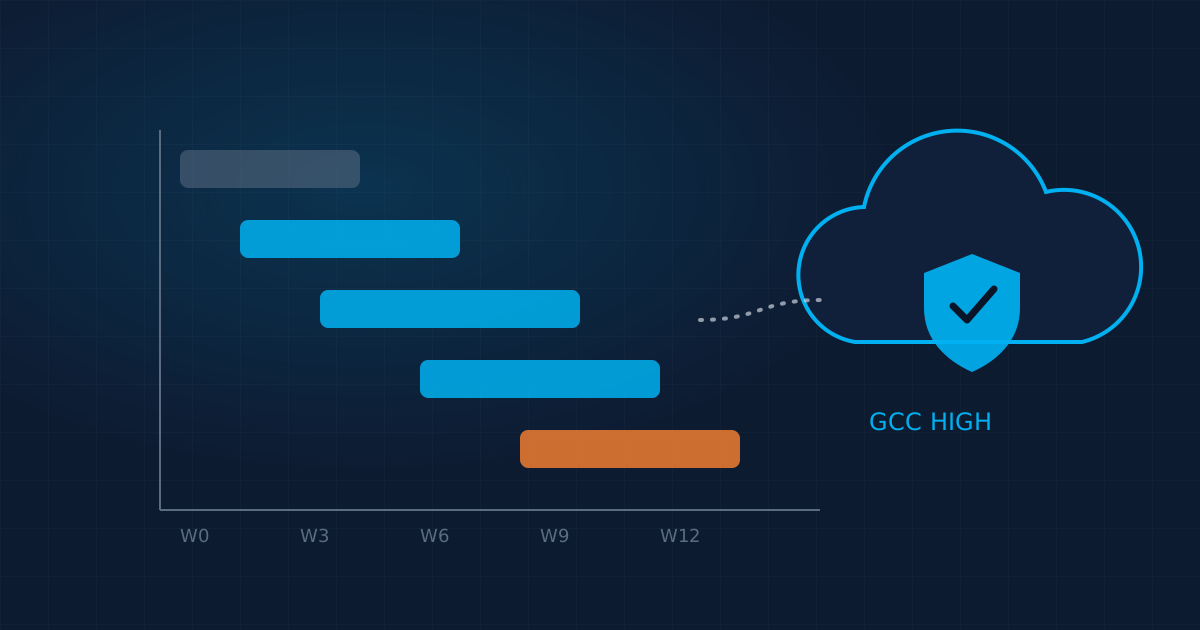
Week ranges below assume the packaged six-week migration. They overlap on purpose, because phases that can run in parallel should.
Discovery & scoping
Teramis Regulated Data Discovery runs first, typically for about three weeks, and tells you where CUI actually lives. Then comes the big decision: enclave or whole org? Discovery identifies the users, systems, and security dependencies that must be addressed, and any reduction in migration scope depends on the verified design. If you're not sure what counts as CUI, this phase answers that.
Eligibility validation + licensing (start immediately, in parallel)
This is the classic hidden lead time. Microsoft must validate your eligibility before GCC High licenses can be issued, and the licenses are sold through specialized channels instead of the commercial storefront. Start this on day one, in parallel with discovery, because everything downstream waits on a tenant.
Identity foundation
This phase covers Entra ID, Conditional Access, and phishing-resistant MFA. Nothing moves before identity, because every mailbox, file, and Teams channel lands on accounts that have to exist, be secured, and be licensed first. Migrations that rush this phase usually get redone.
Mail, files, Teams migration
This is the part users see. Bandwidth and data volume set the pace more than anything else: a lean enclave with tens of gigabytes moves in days, while a whole-org migration with years of SharePoint sprawl takes weeks. That gap is where the Phase 0 scope decision pays off.
Endpoints + DFARS wiring
The work here is Intune baselines, FIPS-validated crypto on devices, and the DFARS 252.204-7012 machinery: a working 72-hour DIBNet reporting path, the medium assurance certificate in hand (it has its own lead time, so request it early), and 90-day media preservation procedures. For GCC High, Microsoft documents DFARS 7012 cloud support, U.S. data residency, and screened U.S.-citizen support staff. In this phase you wire up your side of that commitment.
Cutover + stabilization
DNS flips, the old tenant goes read-only, and hypercare begins. Capture configurations, baselines, and screenshots as you go, because every artifact from this phase feeds the SSP you'll need for CMMC.
That covers the six-week packaged migration. If you're building the full CMMC Factory Baseline, the complete GCC High enclave with the whole compliance stack, plan on roughly twelve weeks typical, with the same caveat that seat count and data volume move it. For what the surrounding program costs, see the CMMC cost planning guide.
The critical path
Some dependencies can't be shortened by adding people or running work in parallel:
- Eligibility → licensing → tenant. Without validation there are no licenses, without licenses there is no tenant, and without a tenant nothing else can start. That chain is why Phase 1 starts on day one, even while discovery is still running.
- Identity → everything. Mail, files, Teams, and endpoints all land on identities. Conditional Access and MFA have to be right before the first mailbox moves.
- Discovery → seat count. You can't finalize licensing quantities, or the budget, until you know who actually touches CUI. Guess high and you overbuy; guess low and you stall mid-flight.
What blows up timelines
- Unknown CUI. Teams that can't say where regulated data lives tend to panic and migrate everything, which means the most seats, the most data, and the longest calendar. Running discovery first prevents that.
- Dual-running longer than planned. Two tenants mean two licensing bills, and some users keep working in the old one. Set a hard read-only date and hold it.
- ITAR residency mistakes discovered mid-flight. If export-controlled technical data is in scope, GCC High's US-persons and US-sovereign guarantees are close to mandatory in practice. Finding ITAR data halfway through a migration aimed at the wrong platform means restarting the plan.
- Training lag at cutover. If users meet the new tenant on cutover morning, week one of hypercare becomes a help desk siege. Train users during Phase 3, before cutover.
The enclave alternative
An enclave can limit migration to appropriate CUI users and systems, while accounting for shared identity, endpoints, and security services. Discovery determines whether that design is appropriate. Migration duration and cost depend on the verified scope, data volumes, integrations, and customer prerequisites.
Connect the roadmap to a working environment.
Our GCC High migration service covers the move from planning through operations. Read the Allyon CMMC Level 2 case study for a client example, and plan ongoing evidence with managed compliance.
Want this timeline mapped to your org?
Tell us your seat count, your contracts, and where CUI probably lives, and a practitioner will send back a migration roadmap with phases, dates, and the licensing order you should place this week. Or email rj@indirectit.com directly.