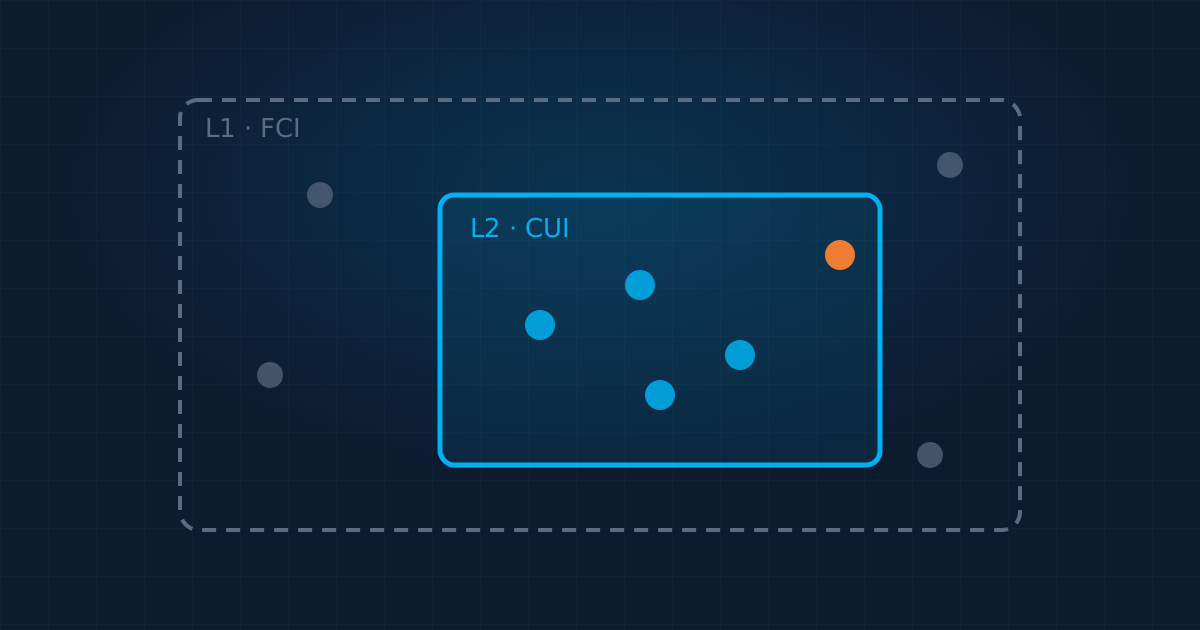
Introduction to CMMC Scoping
Accurate scoping is one of the first and most important steps toward CMMC compliance. Good scoping keeps the compliance effort manageable, improves your security where it counts, and helps you avoid costly mistakes.
What is CMMC Scoping, and Why Does It Matter?
CMMC scoping draws the boundary around the systems, networks, assets, and processes that must comply with CMMC. That boundary determines the scope and cost of your assessments and how effective your security controls are.
Benefits of Accurate Scoping
A well-defined scope cuts unnecessary spending on compliance and infrastructure. Clear boundaries make audits simpler and certification faster, and precisely identified assets let you aim your security controls where they do the most good.
Understanding CMMC Levels: Level 1 vs. Level 2
CMMC has multiple maturity levels, primarily Level 1 (Foundational) and Level 2 (Advanced).
Level 1 (Foundational)
Level 1 covers the basic safeguarding requirements for FCI in FAR Clause 52.204-21. Every contractor at Level 1 must implement the 15 basic security requirements to safeguard FCI.
- Applies to organizations handling only Federal Contract Information (FCI).
- Basic cybersecurity practices to safeguard information.
Example Scenario
- A subcontractor performing administrative tasks without handling Controlled Unclassified Information (CUI) requires only Level 1 compliance.
Level 2 (Advanced)
Level 2 covers the security requirements for CUI in NIST SP 800-171 Rev 2, required by DFARS Clause 252.204-7012. It applies to contractors handling CUI, CTI, ITAR, or other export-controlled data that is categorized as CUI.
- Required for organizations storing, processing, or transmitting CUI.
- More stringent security practices based on NIST SP 800-171.
Example Scenario
- A manufacturing company producing parts for a DoD contract, directly managing CUI documentation, must meet Level 2 standards.
Organization-Wide vs. Enclave Approach
Setting your scope often means choosing between an organization-wide approach and an enclave. The right choice depends on your organization's needs and resources.
Organization-Wide Approach
An organization-wide approach applies CMMC requirements to every system, network, and process in the organization, so all of your IT infrastructure, in administrative and operational departments alike, must meet the required cybersecurity controls.
Pros
- Simplifies compliance management.
- Broad cybersecurity improvements across the organization.
Cons
- Potentially higher costs.
- Increased complexity.
Enclave Approach
An enclave approach limits compliance to a clearly defined subset, or "enclave," of the organization. Only the systems, processes, and personnel that handle sensitive information (such as Controlled Unclassified Information or Federal Contract Information) must meet CMMC requirements, and all other systems stay outside the compliance scope.
Pros
- Lower costs due to reduced compliance boundaries.
- Easier to manage focused security controls.
Cons
- Requires strict isolation and boundary maintenance.
- Risk of inadequate isolation leading to scope creep.
When to Choose Which
Go organization-wide if your organization works with CUI frequently and across multiple departments. An enclave suits organizations whose processes for managing sensitive data are clearly defined and isolated.
Step-by-Step Guide to Effective CMMC Scoping
1. Identify Your Information Types
Categorize your assets based on their sensitivity:
- Controlled Unclassified Information (CUI)
- Federal Contract Information (FCI)
- Security protection assets
- Specialized assets
- Contractor risk managed assets
- Out-of-scope assets
2. Asset Inventory
A complete asset inventory includes:
- Hardware and software assets
- Physical locations
- Cloud services and storage solutions
- Data repositories
3. Define System Boundaries
Create clear boundary diagrams:
- Identify connections between internal and external systems.
- Mark which environments handle sensitive data.
- Document interconnections and dependencies.
4. Determine Data Flow and Access Controls
Map how data flows:
- Track how CUI and FCI move through your organization.
- Identify all points of data storage, processing, and transmission.
- Establish and document access control policies and procedures.
Common CMMC Scoping Mistakes
Mistake 1: Overly Broad or Narrow Scopes
Including too many systems adds unnecessary complexity, and including too few leaves vulnerabilities overlooked. Review your data flows regularly and reassess your scope boundaries.
Mistake 2: Misclassification of Assets
The fix is thorough training on CUI handling and classification guidelines.
Mistake 3: Lack of Clear Boundary Definitions
Use visual boundary diagrams and clear, descriptive documentation so nobody has to guess where the scope ends.
Mistake 4: Neglecting Third-Party Vendors and External Connections
Include third-party service providers and external systems in your scoping assessments.
Best Practices for Continuous Compliance
To stay compliant, revisit and adjust your scope boundaries as your organization changes, and keep detailed records of asset inventories, boundary definitions, and control implementations. Routine assessments confirm you are still compliant and surface changes in your infrastructure or data handling processes so you can address them promptly.
How inDirect IT Can Help With CMMC Scoping
CMMC scoping can be difficult. inDirect IT offers three services that help:
- Gap Assessments: Identify gaps in your existing compliance and cybersecurity posture.
- Scoping Workshops: Practitioner-led workshops that define your CMMC scope around your organization's needs.
- CMMC Enclave Solution: Establish a secure, compliant environment for your sensitive data.
Contact us for a consultation or a detailed assessment of where your compliance stands today.
Conclusion
Accurate scoping makes CMMC compliance faster and cheaper to achieve. Plan carefully, define your boundaries clearly, and keep reviewing them, and your organization can meet its cybersecurity obligations with confidence.
Want current guidance on CMMC scoping?
This post was first published in July 2025, and scoping guidance has evolved since. A practitioner can walk you through what Level 1 vs. Level 2 scoping looks like today and how to right-size your boundary. Or email rj@indirectit.com directly.